Choosing the right 3D scanning technology is one of the most important decisions when investing in professional scanning equipment. While both structured light and laser scanners can produce highly accurate digital models, each technology offers distinct advantages depending on the application.
Understanding the differences can help organizations select the best solution for reverse engineering, inspection, manufacturing, and product development.
What Is Structured Light Scanning?
Structured light scanners project a pattern of light onto an object’s surface.
Cameras capture how the pattern deforms across the geometry, allowing the system to calculate accurate 3D coordinates.
This method enables rapid data collection and detailed surface capture.
Benefits of Structured Light Scanners
- Fast scanning speed
- High-resolution data
- Excellent surface detail
- User-friendly workflows
- Ideal for complex geometries
Common Applications
- Reverse engineering
- Product development
- Heritage preservation
- Medical applications
- Industrial design
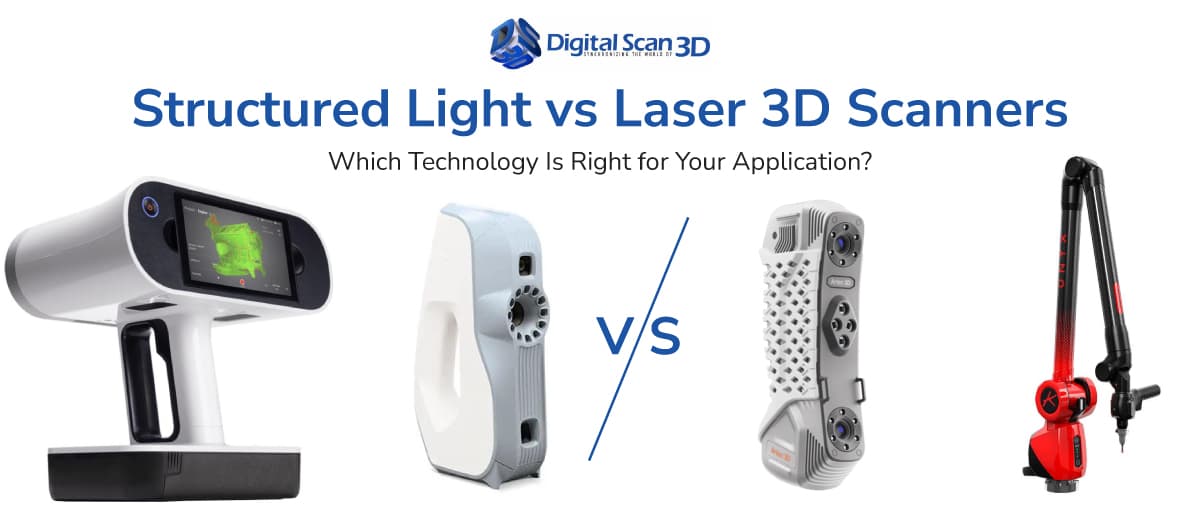
Popular structured light scanners include:
What Is Laser Scanning?
Laser scanners use laser lines or laser patterns projected onto an object.
Sensors capture the reflected light and calculate precise measurements across the surface.
Laser technology is often associated with high-accuracy industrial applications.
Benefits of Laser Scanners
- Excellent precision
- Reliable industrial performance
- Strong inspection capabilities
- Suitable for large and complex parts
- Metrology-focused workflows
Common Applications
- Quality inspection
- Aerospace manufacturing
- Automotive production
- Industrial metrology
- Large-scale engineering
Popular laser scanners include:
Accuracy Comparison
Both technologies can achieve highly accurate results when used correctly.
In general:
- Structured light scanners excel at capturing detailed geometry quickly.
- Laser scanners often provide advantages in metrology and inspection applications.
The required level of accuracy should always be evaluated against the project requirements.
Speed Comparison
Structured light scanners are often preferred when speed is a priority.
Their ability to capture large amounts of data quickly makes them ideal for:
- Product development
- Reverse engineering
- Design workflows
Laser scanners typically prioritize measurement precision and inspection capabilities.
Reverse Engineering Applications
For reverse engineering projects, structured light scanners are often the preferred choice because they:
- Capture complex shapes efficiently
- Produce high-resolution mesh data
- Support scan-to-CAD workflows
This is why scanners such as Artec Leo and Artec Space Spider are frequently used in reverse engineering environments.
Inspection Applications
For dimensional inspection and quality control, laser scanning technology often provides significant advantages.
When paired with inspection software such as Geomagic Control X or PolyWorks, laser scanners can support advanced measurement and validation workflows.
Which Technology Should You Choose?
Choose Structured Light If You Need:
- Reverse engineering
- Product development
- Design applications
- High-resolution surface capture
- Fast scanning workflows
Choose Laser Scanning If You Need:
- Quality inspection
- Industrial metrology
- Manufacturing validation
- First article inspection
- Precision measurement workflows
Final Thoughts
Both structured light and laser scanning technologies play important roles in modern engineering and manufacturing.
Structured light scanners excel in reverse engineering and design applications, while laser scanners are often preferred for inspection and metrology workflows. The best choice ultimately depends on your objectives, accuracy requirements, and long-term workflow needs.