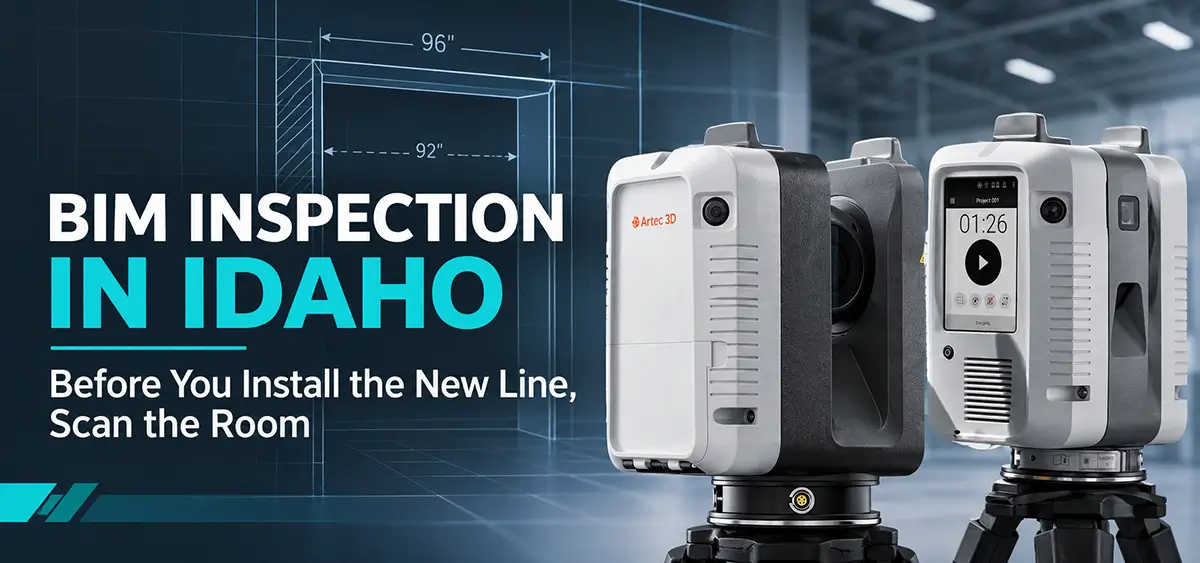
Picture installation day. The crane is booked, the new tank has arrived on a flatbed, and somebody realizes the doorway is a couple of inches narrower than the plan says it should be.
Nobody lied. The drawing was right when it was made. Then came a rerouted pipe, an added platform, a wall that shifted a little during the last expansion. Buildings change quietly, and paper doesn’t keep up.
That gap between the drawing and the building is where 3D scanning services in Idaho earn their place. Scan the space once, and everyone from the engineers to the installers works from what’s actually there.
Idaho is in the middle of a building boom
An industry tracker reported roughly $27 billion in projects under construction in Idaho at the time of its report, most of it tied to semiconductors, including the $25 billion fab Micron is building in Boise. Another $2.8 billion or so is spread across other industries, with dairy making up nearly $800 million of it, including a 500,000-square-foot expansion at a yogurt plant in Twin Falls. Idaho also ranks third in the nation for milk production.
Big capital projects have a habit of landing next to, around and inside things that already exist. Suppliers add lines, food plants grow their footprints, and contractors squeeze new equipment into buildings that have been modified more than once.
Why the room matters as much as the machine
Equipment arrives with exact dimensions. Buildings usually don’t. Old plans miss modifications, and measuring a large space by hand means hundreds of readings and a few quiet mistakes. If new equipment, piping or platforms are designed from that old drawing, the mistakes turn into rework on site, which is where rework costs the most.
3D scanning services in Idaho: what we capture
For large spaces and equipment we use long-range scanners such as the Artec Ray II, which is built for production lines, big machinery and whole facilities, and we add handheld scanners for the details that need more resolution. The result is a dense point cloud: a measured copy of the space that your engineers can open, measure and design against.
From the scan we can deliver point cloud and mesh data, or build CAD and BIM models so your design team starts from reality instead of from the last set of drawings.
The old machine in the corner
Food and dairy plants often run equipment that has been in place for decades. When the original maker no longer supplies a part, we scan what you have and rebuild it in CAD, so a machinist can produce a new one. It’s the same idea as a room scan, only smaller; the details are in our reverse engineering work.
Is it worth scanning? Ask yourself these
You don’t need a formal study to decide. If you answer yes to any of these, it’s probably worth a conversation:
- Are your drawings older than the last time anyone modified the space?
- Is your shutdown window short enough that a measuring mistake would really hurt?
- Is something expensive being custom-fabricated to fit a space you haven’t measured digitally?
- Do several teams (engineering, installers, contractors) need to agree on the same dimensions?
One scan, shared with everyone, replaces a lot of “I thought it was…” conversations.
If you’re in Idaho: how we work
We’re in Portland, Oregon, and we work with customers throughout the US and Canada. You can’t ship a room, so for facility work we come to you. Smaller parts can travel to our main facility instead. We’ll plan the details with you first, including access and timing.
Frequently Asked Questions
Depending on the job: point clouds or meshes, CAD models, or BIM models. We agree the format with you up front.
That depends on the scanner we use. For parts, our scanners work between 0.01 and 0.1 mm; large-space scanning works at a different scale, and we’ll tell you what to expect before we start.
No. If you have them, they help us see what has changed. If you don’t, the scan becomes your record.
Start with one room, one line or one machine
Tell us what you’re planning to install, replace or expand, and roughly how big the space is. We’ll tell you what a scan would capture, what you’d get back and whether it’s worth doing. Call 503.388.8888 or use our contact us.