As manufacturing tolerances continue to tighten, quality control teams need faster and more reliable methods for inspecting parts and assemblies. Traditional inspection tools such as calipers, gauges, and coordinate measuring machines (CMMs) remain valuable, but they often struggle to keep pace with modern production demands.
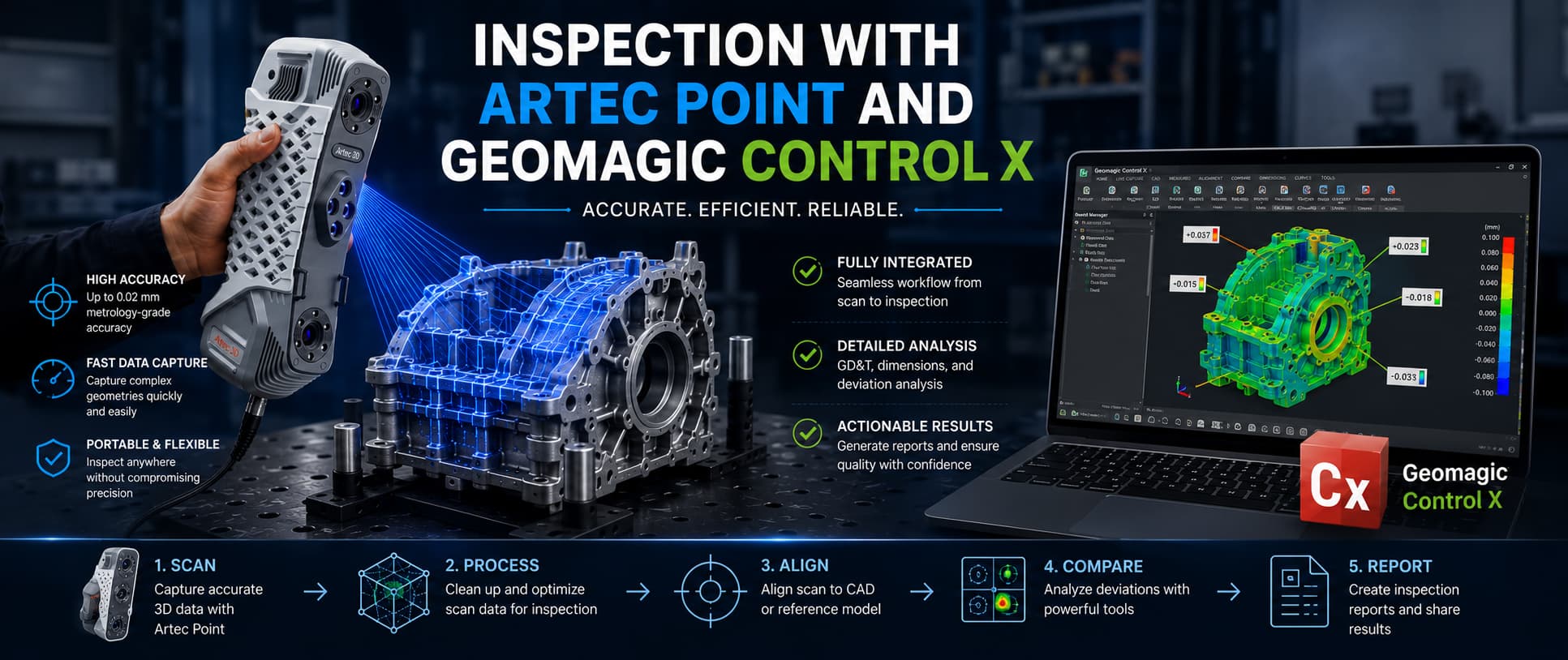
By combining the Artec Point 3D Scanner with Geomagic Control X, manufacturers can create a powerful digital inspection workflow that delivers accurate measurements, comprehensive reporting, and faster decision-making.
Why Modern Inspection Requires More Than Traditional Measurements
Conventional inspection methods typically measure only selected points on a component. While effective for simple parts, complex geometries often require significantly more data to verify dimensional accuracy.
3D scanning provides a more complete approach by capturing millions of measurement points across the entire surface of a part. This allows inspectors to identify deviations that might otherwise go unnoticed.
Benefits include:
- Faster inspections
- Complete surface analysis
- Improved reporting
- Reduced inspection bottlenecks
- Better traceability
What Makes Artec Point Different?
Artec Point is designed for high-accuracy industrial inspection and metrology applications.
Its laser-based scanning technology captures detailed geometry suitable for demanding manufacturing environments.
Common applications include:
- Machined parts
- Castings
- Tooling inspection
- Automotive components
- Aerospace assemblies
- Production validation
Because of its speed and precision, Artec Point is often used where traditional inspection methods become time-consuming or impractical.
Understanding Geomagic Control X
Geomagic Control X is professional inspection software developed specifically for dimensional analysis and quality control.
The software allows users to compare scanned data against CAD models and engineering specifications.
Key capabilities include:
- Deviation analysis
- GD&T evaluation
- Dimensional measurements
- First article inspection
- Automated reporting
- Trend analysis
The result is a streamlined workflow that helps manufacturers improve quality while reducing inspection time.
The Inspection Workflow
Step 1: Scan the Part
The process begins by capturing the manufactured component using Artec Point.
The scanner creates a detailed digital representation of the part’s geometry.
Examples include:
- Production components
- Injection molded parts
- Metal castings
- Machined assemblies
The goal is to accurately capture the entire surface for analysis.
Step 2: Process the Scan Data
The scan data is processed and optimized using Artec Studio.
Typical processing tasks include:
- Scan alignment
- Noise removal
- Mesh generation
- Data optimization
A clean mesh ensures accurate downstream inspection results.
Step 3: Import Data into Geomagic Control X
The processed scan and original CAD model are imported into Geomagic Control X.
The software aligns both datasets and prepares them for comparison.
This creates the foundation for a complete inspection workflow.
Step 4: Perform Deviation Analysis
One of the most powerful features of Control X is color-map deviation analysis.
The software visually highlights:
- Areas within tolerance
- Areas exceeding tolerance
- Surface variations
- Manufacturing defects
Engineers can quickly identify problem areas without manually measuring multiple locations.
Step 5: Validate Critical Dimensions
Inspectors can evaluate:
- Hole diameters
- Distances
- Angles
- Surface profiles
- Flatness
- Position tolerances
These measurements can be compared directly against engineering requirements.
Step 6: Generate Inspection Reports
Modern manufacturing requires detailed documentation.
Geomagic Control X can generate professional reports containing:
- Color maps
- Measurement tables
- Pass/fail results
- Statistical summaries
These reports support quality assurance, compliance, and customer requirements.
Common Industry Applications
Automotive Manufacturing
Automotive suppliers use digital inspection workflows to validate production parts and maintain consistency across manufacturing runs.
Aerospace
Aerospace manufacturers rely on dimensional verification to ensure parts meet strict engineering specifications.
Tool and Mold Manufacturing
Inspecting molds and tooling before production helps prevent costly manufacturing issues.
Precision Engineering
High-value components often require comprehensive inspection data to verify quality and performance.
Why Manufacturers Are Adopting Digital Inspection
Companies are increasingly moving toward 3D inspection because it offers several advantages:
Faster Results
Inspection tasks that once required hours can often be completed much more efficiently.
Improved Accuracy
Full-surface analysis provides a more complete picture of part quality.
Better Documentation
Digital reports improve traceability and simplify customer communication.
Reduced Scrap
Identifying problems early helps prevent defective parts from moving further through production.
Final Thoughts
The combination of Artec Point and Geomagic Control X provides manufacturers with a modern approach to dimensional inspection and quality control.
By replacing limited point measurements with complete surface analysis, organizations can improve accuracy, accelerate inspections, and make better-informed manufacturing decisions. Whether performing first article inspections, validating production parts, or supporting quality assurance initiatives, this workflow delivers the speed and precision required by today’s manufacturing environments.