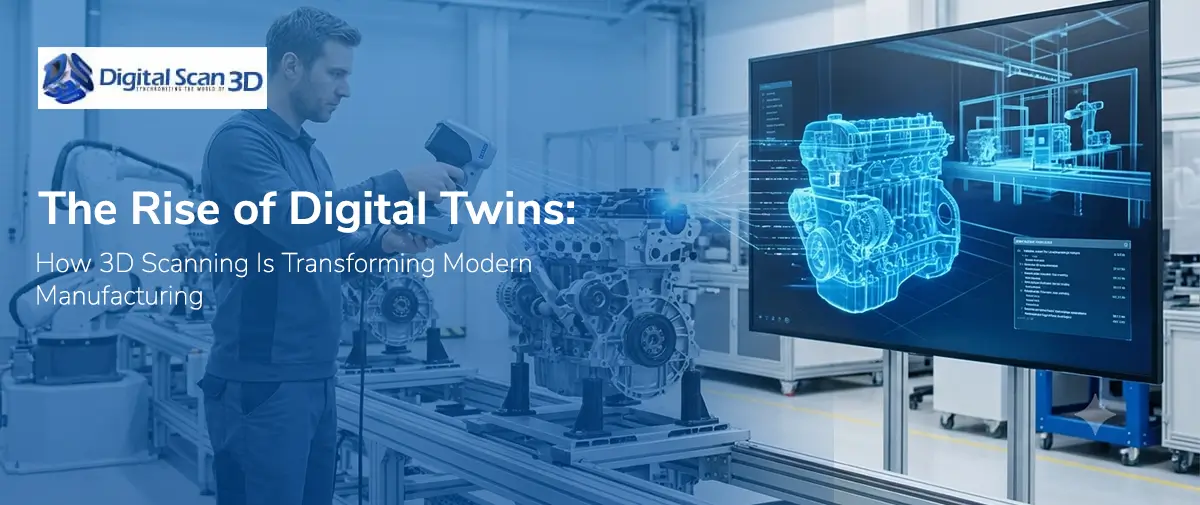
Manufacturing is undergoing one of the biggest technological shifts since the introduction of computer-aided design (CAD). Today, manufacturers are not only producing physical products but also creating accurate digital representations of machines, facilities, and components. These virtual replicas—known as digital twins—are changing how organizations design, inspect, maintain, and improve their operations.
At the core of every successful digital twin is reliable data. This is where professional 3D scanning plays a vital role. By capturing millions of accurate measurement points from physical objects, modern 3D scanners enable manufacturers to build precise digital models that support engineering, quality control, predictive maintenance, and product lifecycle management.
In this article, we’ll explore what digital twins are, why they matter, and how 3D scanning is making them more accessible across industries.
What Is a Digital Twin?
A digital twin is a virtual representation of a physical object, machine, production line, or facility. Unlike a simple 3D model, a digital twin is designed to reflect the real-world asset throughout its lifecycle.
Digital twins can be used to:
- Visualize complex assets
- Monitor equipment performance
- Simulate design changes
- Improve maintenance planning
- Support quality assurance
- Preserve digital records of critical infrastructure
For manufacturers, digital twins provide valuable insights without interrupting production or risking damage to physical equipment.
Why Accurate 3D Data Matters
A digital twin is only as accurate as the information used to create it.
Traditional measurement methods capture only selected dimensions, leaving gaps in the overall geometry. Professional 3D scanners capture complete surface data, ensuring engineers have a detailed representation of the asset.
Benefits include:
- Complete surface geometry
- Faster data collection
- Reduced human error
- Improved dimensional accuracy
- Better engineering documentation
This high-quality data forms the foundation for reliable digital twins.
How 3D Scanning Supports Digital Twin Creation
1. Capturing Existing Assets
Many factories still rely on equipment that has been in service for decades. Engineering drawings may be incomplete, outdated, or unavailable.
Using handheld and long-range 3D scanners, manufacturers can quickly digitize:
- Production machinery
- Spare parts
- Tooling
- Industrial equipment
- Factory layouts
This creates accurate digital records for future engineering projects.
2. Accelerating Reverse Engineering
Legacy components often require redesign or replacement.
3D scanning simplifies reverse engineering by capturing the exact geometry of existing parts, allowing engineers to recreate editable CAD models using dedicated reverse engineering software.
This reduces manual measurements and accelerates product development.
3. Improving Quality Inspection
Digital twins also support inspection workflows.
By comparing scanned components against CAD models, manufacturers can identify dimensional deviations before products reach customers.
This helps improve product consistency, reduce scrap, and strengthen quality assurance processes.
4. Supporting Predictive Maintenance
Equipment downtime can be costly.
By maintaining accurate digital models of machines and critical components, maintenance teams can:
- Monitor wear over time
- Plan component replacements
- Document repairs
- Reduce unexpected failures
Digital twins provide valuable reference data throughout the equipment lifecycle.
Industries Benefiting from Digital Twins
Manufacturing
Manufacturers use digital twins to optimize production, validate designs, and improve quality control.
Automotive
Vehicle manufacturers leverage digital twins to inspect components, redesign legacy parts, and streamline product development.
Aerospace
Digital models help preserve legacy aircraft components, support maintenance programs, and validate high-precision assemblies.
Energy and Utilities
Power generation facilities use digital twins to document critical infrastructure and support long-term asset management.
Industrial Equipment
Manufacturers of heavy machinery create digital twins to improve serviceability, replacement part production, and maintenance planning.
Building a Digital Twin Workflow
A typical workflow begins with capturing accurate scan data using a professional 3D scanner.
The data is then processed to generate a clean digital mesh before being converted into engineering-ready CAD models or used directly for inspection and documentation.
A typical workflow includes:
- Scan the physical asset
- Process scan data
- Generate a high-quality mesh
- Create CAD models when required
- Compare manufactured parts to design data
- Store digital records for future use
This workflow supports engineering teams throughout the product lifecycle.
Why Digital Twins Are Becoming an Industry Standard
Several factors are driving rapid adoption:
- Industry 4.0 initiatives
- Aging industrial infrastructure
- Increased automation
- Demand for predictive maintenance
- Faster product development cycles
- Improved collaboration across engineering teams
As organizations continue to digitize operations, digital twins are becoming an essential part of modern manufacturing strategies.
Choosing the Right 3D Scanning Solution
Selecting the appropriate scanner depends on the size, complexity, and accuracy requirements of your project.
For example:
- Artec Leo is well suited for capturing medium-to-large industrial components with fast, wireless workflows.
- Artec Space Spider excels at scanning intricate parts requiring high levels of detail.
- Artec Ray enables accurate capture of large facilities, production lines, and industrial environments.
- Artec Point supports high-accuracy inspection and metrology applications.
Combined with software such as Artec Studio, Geomagic Design X, Geomagic Control X, Geomagic Wrap, and PolyWorks, manufacturers can build complete digital engineering workflows from scan acquisition through reverse engineering and quality inspection.
Final Thoughts
Digital twins are no longer limited to large enterprises with specialized engineering teams. Advances in professional 3D scanning and engineering software have made it easier for manufacturers of all sizes to create accurate digital representations of their products, equipment, and facilities.
By combining precise 3D scanning with robust reverse engineering and inspection workflows, organizations can reduce downtime, improve product quality, preserve legacy assets, and make more informed engineering decisions.
As Industry 4.0 continues to evolve, digital twins will play an increasingly important role in helping manufacturers stay competitive, agile, and prepared for the future.