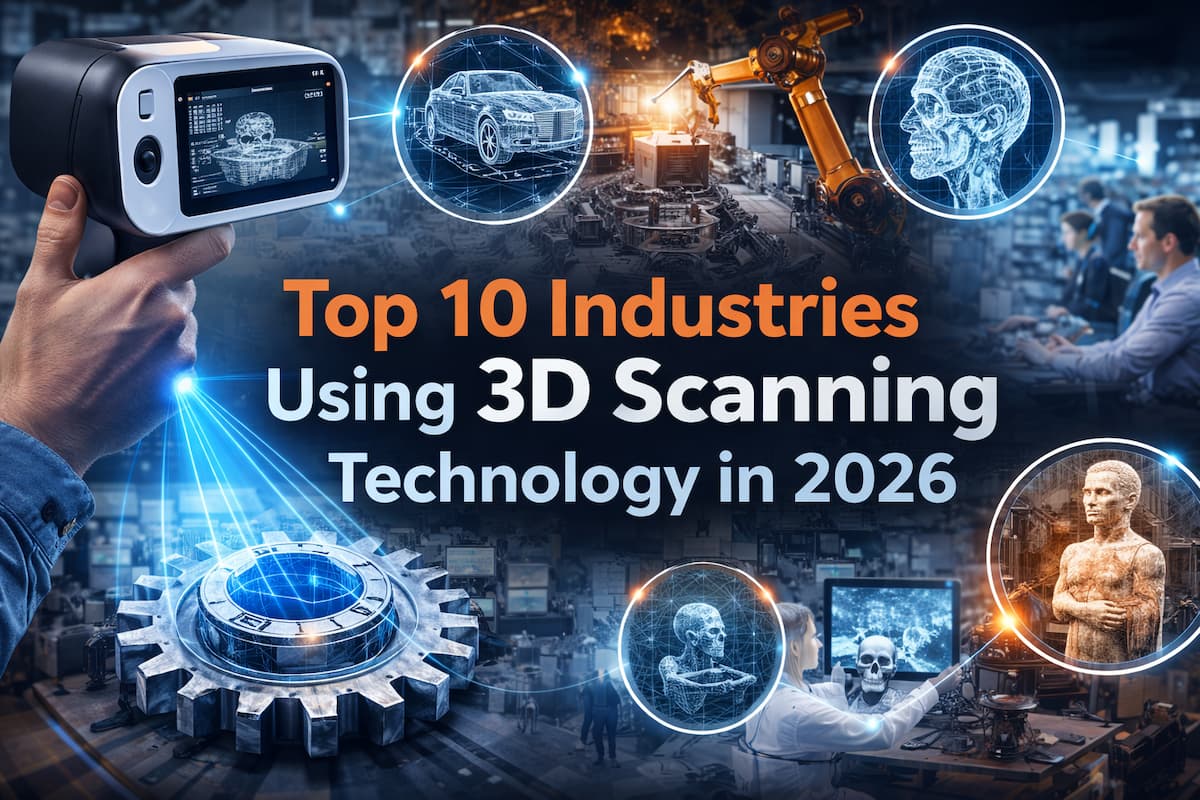
3D scanning technology has rapidly evolved into a critical tool for modern industries. By capturing the exact geometry of physical objects and converting them into digital 3D models, businesses can improve design accuracy, speed up product development, and reduce production costs. In 2026, 3D scanning is no longer limited to research labs—it is widely used across manufacturing, healthcare, construction, and many other sectors.
This article explores the top 10 industries that are transforming their operations with 3D scanning technology in 2026.
1. Manufacturing Industry
Manufacturing is one of the largest adopters of 3D scanning technology. Companies use it for quality control, reverse engineering, and product design.
Key applications include:
- Inspecting manufactured parts for accuracy
- Comparing CAD models with real-world components
- Detecting defects in production lines
- Reverse engineering legacy parts
With high-precision scanners, manufacturers can identify dimensional errors quickly and ensure consistent product quality.
2. Automotive Industry
The automotive industry relies heavily on 3D scanning for design, prototyping, and inspection. Engineers use scanners to capture the exact dimensions of vehicle components and analyze them digitally.
Common uses include:
- Vehicle body inspection
- Reverse engineering automotive parts
- Custom vehicle modifications
- Prototype validation
3D scanning significantly reduces development time while improving design accuracy for modern vehicles.
3. Aerospace Industry
Precision is critical in aerospace engineering, where even the smallest measurement error can affect performance and safety.
3D scanning helps aerospace companies with:
- Aircraft component inspection
- Surface analysis and aerodynamic testing
- Reverse engineering legacy aircraft parts
- Maintenance and repair documentation
Because aerospace components require extreme precision, high-resolution scanning technologies are widely used in the sector.
4. Healthcare and Medical Industry
Healthcare has embraced 3D scanning for medical modeling, prosthetics, and surgical planning.
Key applications include:
- Creating custom prosthetics and orthotics
- Designing dental implants and aligners
- Patient body scanning for medical devices
- Surgical planning using accurate anatomical models
The ability to create personalized medical solutions makes 3D scanning a powerful tool in modern medicine.
5. Construction and Architecture
Construction companies use 3D scanning to create accurate digital representations of buildings and infrastructure.
Typical applications include:
- Building information modeling (BIM)
- Structural inspection
- Construction site documentation
- Renovation planning
Laser scanning allows engineers and architects to capture millions of data points, creating precise digital models of buildings and construction sites.
6. Cultural Heritage and Archaeology
Museums, historians, and archaeologists use 3D scanning to preserve historical artifacts and monuments digitally.
Benefits include:
- Digital preservation of fragile artifacts
- Restoration planning for damaged objects
- Creating virtual museum exhibits
- Historical documentation
By digitizing artifacts, institutions can protect cultural heritage for future generations.
7. Energy and Power Industry
The energy sector uses 3D scanning to inspect complex equipment and infrastructure such as power plants, pipelines, and turbines.
Common uses include:
- Inspection of power plant components
- Maintenance planning for turbines
- Pipeline monitoring
- Digital twin creation for facilities
3D scanning improves safety and efficiency by allowing engineers to analyze structures without direct physical measurements.
8. Consumer Products and Product Design
Companies that design consumer products use 3D scanning to accelerate product development and prototyping.
Applications include:
- Scanning physical prototypes
- Creating CAD models from existing products
- Rapid design iteration
- Competitive product analysis
This technology allows designers to quickly convert real-world objects into editable digital models.
9. Entertainment and Media
The entertainment industry uses 3D scanning for film production, gaming, and virtual reality.
Examples include:
- Scanning actors for realistic digital characters
- Creating 3D assets for video games
- Visual effects in movies
- Virtual reality environments
3D scanning helps studios create highly realistic digital environments and characters.
10. Education and Research
Educational institutions and research centers use 3D scanning for engineering research, scientific studies, and training.
Students and researchers use scanning technology to:
- Analyze complex objects and structures
- Study mechanical components
- Develop new manufacturing techniques
- Create interactive learning models
As the technology becomes more accessible, universities are increasingly integrating it into engineering and design programs.
The Growing Future of 3D Scanning
The adoption of 3D scanning technology is expected to grow significantly in the coming years. Advancements in portable scanners, AI-based data processing, and cloud-based modeling are making scanning faster, more affordable, and easier to integrate into business workflows.
From manufacturing and healthcare to entertainment and archaeology, 3D scanning is transforming how industries capture and use physical data.
Conclusion
3D scanning technology is reshaping industries by enabling accurate digital models, faster product development, and improved quality control. In 2026, businesses that adopt 3D scanning gain a competitive advantage through increased efficiency, reduced errors, and enhanced innovation.
As technology continues to advance, the range of applications will expand even further—making 3D scanning an essential tool for the future of engineering, manufacturing, and digital transformation.