Discover how the Artec Micro II automated 3D scanner is revolutionizing precision manufacturing with micron-level accuracy and seamless software integration for quality control and product development.
Understanding the Artec Micro II Scanner Technology and Core Capabilities
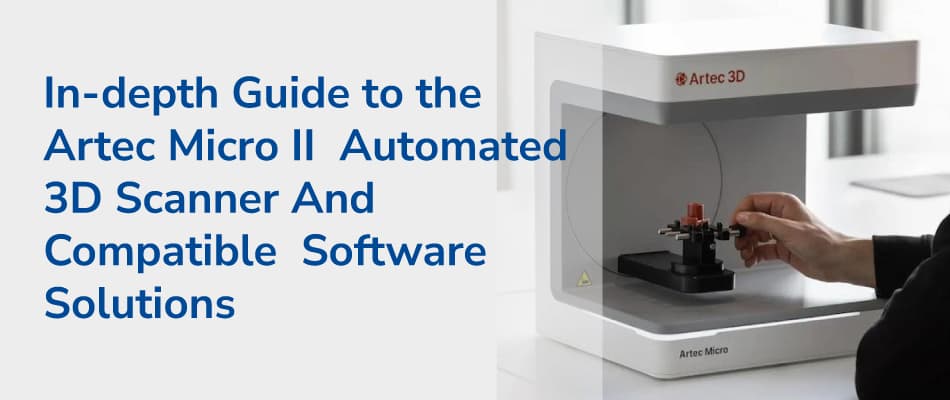
The Artec Micro II represents a significant advancement in desktop 3D scanning technology, specifically engineered to capture small objects with exceptional precision and detail. This automated 3D scanner utilizes dual-camera blue LED structured light technology to achieve point accuracy up to 5 microns and resolution down to 10 microns, making it one of the most precise desktop scanners available for industrial and professional applications. The scanner’s compact footprint and enclosed design make it ideal for laboratory and workshop environments where space efficiency and controlled scanning conditions are paramount.
At the core of the Artec Micro II’s capabilities is its fully automated scanning workflow, which eliminates the need for manual repositioning and operator intervention during the capture process. The system features a precision motorized rotating platform that automatically positions objects through a complete 360-degree scan cycle, while the dual-camera system captures overlapping data from multiple angles. This automation ensures consistent, repeatable results and dramatically reduces the time required to digitize complex geometries compared to manual scanning approaches.
The scanner’s field of view accommodates objects ranging from 30 x 30 mm up to 90 x 60 mm, with a working distance optimized for small parts that demand ultra-high resolution. The Artec Micro II excels at capturing intricate surface details, fine textures, and complex geometries that would be challenging or impossible to measure using traditional contact-based metrology equipment. The system’s ability to capture full-color texture information alongside geometric data provides additional value for applications requiring visual documentation or photorealistic digital replicas.
Technical specifications that distinguish the Artec Micro II include its impressive depth of field, which allows for scanning objects with varying heights without requiring multiple setups or focal adjustments. The scanner employs advanced calibration protocols to maintain accuracy across its entire working volume, and the enclosed scanning chamber minimizes the impact of ambient lighting conditions on data quality. These characteristics make the system particularly well-suited for production environments where consistent, high-quality results are essential for quality control and inspection workflows.
Key Applications of Automated 3D Scanning in Modern Manufacturing Environments
The Artec Micro II has established itself as an indispensable tool in reverse engineering applications, where the goal is to create accurate CAD models from physical parts without existing technical drawings. Engineering teams use the scanner to digitize legacy components, competitor products, or worn parts that need remanufacturing. The micron-level accuracy enables engineers to capture dimensional data with sufficient precision to generate manufacturing-ready CAD models, including complex features like undercuts, organic surfaces, and fine mechanical details that are time-consuming to measure using conventional coordinate measuring machines (CMMs).
Quality inspection and dimensional verification represent another critical application domain for the Artec Micro II automated scanner. Manufacturing facilities integrate the system into their quality control workflows to perform first-article inspections, in-process checks, and final product validation against CAD specifications. The scanner generates complete 3D datasets that can be compared against nominal CAD models using color-mapped deviation analysis, instantly revealing manufacturing defects, dimensional variations, or assembly issues. This capability dramatically reduces inspection time compared to traditional tactile measurement methods while providing comprehensive documentation of part conformance.
The jewelry and precious metals industry has embraced the Artec Micro II for design verification, quality assurance, and digital archiving of intricate pieces. Jewelers use the scanner to create precise digital records of custom designs, verify casting quality, and generate files for CNC machining or additive manufacturing of molds and patterns. The system’s ability to capture fine surface details and texture information is particularly valuable for reproducing ornate designs or creating variations of existing pieces while maintaining the original’s character and craftsmanship.
In the electronics and microelectronics sectors, the Artec Micro II serves critical roles in component inspection, PCB analysis, and connector verification. Engineers scan small electronic assemblies to verify solder joint quality, measure component placement accuracy, and inspect housing fit and finish. The scanner’s high resolution enables detection of microscopic defects or dimensional variations that could impact product performance or reliability. Medical device manufacturers similarly rely on the system to inspect surgical instruments, dental prosthetics, orthopedic implants, and other small medical components where precision and quality documentation are paramount for regulatory compliance and patient safety.
Complete Software Ecosystem: From Artec Studio to Third-Party Integration Options
Artec Studio stands as the primary software solution specifically designed to work seamlessly with the Artec Micro II scanner, providing a comprehensive environment for scan acquisition, processing, and analysis. The software features an intuitive interface that guides users through the automated scanning workflow, from initial setup and calibration through final mesh export. Artec Studio’s automated scan alignment algorithms leverage the geometric features captured during the automated rotation sequence to intelligently register multiple scan passes, creating a complete 3D model without requiring manual alignment or the placement of reference markers on the object.
The mesh processing capabilities within Artec Studio are specifically optimized for the high-resolution data generated by the Artec Micro II. The software includes advanced filtering tools to remove noise and outliers while preserving fine surface details, hole-filling algorithms to address gaps in scan coverage, and mesh simplification options that reduce polygon count without sacrificing geometric accuracy. Users can apply smoothing operations with precise control over their intensity, ensuring that critical dimensional features remain intact while improving overall surface quality. The software also captures and processes texture information, mapping photorealistic color data onto the 3D geometry for applications requiring visual fidelity.
Artec Studio incorporates powerful measurement and inspection tools that enable users to extract dimensional information directly from scan data. The software supports point-to-point measurements, diameter calculations, angle measurements, and surface area computations. More advanced inspection capabilities include best-fit geometric primitive fitting (cylinders, planes, spheres) and deviation analysis comparing scan data against imported CAD references. These inspection tools generate detailed reports with color-mapped deviation visualizations, making it easy to communicate quality issues or manufacturing variations to stakeholders. The software’s export options support a wide range of industry-standard formats including STL, OBJ, PLY, ASCII, and STEP, ensuring compatibility with downstream CAD, CAM, and inspection workflows.
For organizations requiring advanced reverse engineering capabilities, the Artec Micro II integrates seamlessly with Geomagic Design X, widely recognized as the industry-leading software for converting scan data into parametric CAD models. The workflow typically involves processing raw scan data in Artec Studio to create a clean, optimized mesh, then exporting to Geomagic Design X for feature extraction and solid model creation. Design X’s automated and guided feature recognition tools can identify geometric primitives, extract sketch profiles, and build parametric features that match design intent, significantly accelerating the reverse engineering process compared to manual CAD recreation.
Additional third-party software integration options extend the Artec Micro II’s utility across specialized application domains. Metrology software packages such as Geomagic Control X, PolyWorks Inspector, and ZEISS INSPECT provide advanced inspection and quality control capabilities with sophisticated GD&T analysis, statistical process control, and comprehensive reporting features. CAD platforms including Autodesk Fusion 360, SOLIDWORKS, and Siemens NX can directly import scan data for hybrid modeling workflows that combine traditional parametric design with organic surfaces derived from physical objects. For manufacturing applications, CAM software can utilize scan-derived models to generate toolpaths for CNC machining, while additive manufacturing workflows benefit from the high-resolution mesh data for producing accurate reproductions or creating molds and patterns.
Maximizing Scan Quality and Workflow Efficiency with Best Practice Techniques
Achieving optimal scan quality with the Artec Micro II begins with proper object preparation and positioning. While the scanner performs well on many surface types, highly reflective or transparent materials may require surface treatment with scanning spray or powder to ensure consistent light reflection. The application of a thin, uniform coating of scanning spray creates a matte surface that improves data capture quality without significantly affecting dimensional accuracy. Objects should be positioned on the rotating platform to maximize visibility of critical features, and when necessary, multiple scans from different mounting orientations can be combined to achieve complete coverage of complex geometries.
The automated scanning workflow in Artec Studio offers multiple scanning modes optimized for different object characteristics and quality requirements. Understanding when to use rapid scanning modes versus high-resolution modes impacts both scan duration and data quality. For objects with relatively simple geometry, faster scanning modes provide sufficient detail while minimizing capture time. Complex parts with intricate features benefit from high-resolution modes that capture additional data points and textures, even though scan times increase. The software’s preview capabilities allow operators to evaluate initial scan quality and make adjustments to scanning parameters before committing to a full capture sequence.
Post-processing techniques within Artec Studio significantly influence final model quality and usability. A systematic approach to scan processing typically begins with outlier removal to eliminate erroneous data points caused by ambient light interference or edge effects. Following initial cleanup, global registration algorithms refine the alignment between multiple scan passes, minimizing registration errors and ensuring geometric consistency throughout the model. Sharp feature preservation filters should be applied cautiously, as overly aggressive smoothing can round sharp edges and eliminate fine details that may be critical for dimensional verification or reverse engineering applications. Experienced users develop processing templates that standardize workflows for recurring part types, ensuring consistent results and reducing processing time.
Efficient workflow design extends beyond the scanning and processing steps to encompass data management and integration with downstream applications. Establishing consistent file naming conventions, organized directory structures, and metadata documentation practices becomes increasingly important as scan libraries grow. Organizations should develop standard operating procedures that define acceptable scan quality criteria, processing parameters, and inspection methodologies to ensure repeatability across different operators and projects. Integration scripts and automated export routines can streamline the transfer of processed scan data to CAD, CAM, or inspection software, eliminating manual file handling steps that introduce delays and potential errors. Regular calibration verification and system maintenance according to manufacturer recommendations ensure the scanner maintains its specified accuracy over time.
ROI Analysis and Strategic Implementation for Manufacturing Quality Control
Evaluating the return on investment for the Artec Micro II automated 3D scanner requires consideration of both direct cost savings and broader operational improvements. Organizations replacing traditional tactile measurement methods with 3D scanning typically experience dramatic reductions in inspection time—tasks that might require hours with CMM touch probes can often be completed in minutes with automated scanning. This time compression enables more frequent quality checks, earlier detection of manufacturing issues, and faster response to quality problems. The comprehensive nature of scan data, which captures complete surface geometry rather than isolated measurement points, reduces the risk of missing critical defects that fall between programmed measurement locations on traditional CMM inspection routines.
Beyond direct inspection time savings, the Artec Micro II enables quality control capabilities that were previously impractical or impossible. The ability to perform 100% inspection of complex geometries rather than sampling representative features provides higher confidence in product conformance and reduces the risk of shipping defective parts. Digital archiving of scan data creates permanent quality records that support traceability requirements, facilitate root cause analysis of field failures, and provide baseline references for future production runs. Organizations in regulated industries such as medical devices and aerospace find particular value in the comprehensive documentation capabilities that 3D scanning provides for audit and compliance purposes.
Strategic implementation of the Artec Micro II within manufacturing operations requires thoughtful consideration of workflow integration and organizational change management. Successful deployments typically begin with pilot projects focused on specific parts or processes where the scanner’s capabilities address known pain points—such as complex parts that are difficult to fixture on CMMs, high-mix low-volume production requiring frequent inspection program changes, or reverse engineering projects with aggressive timelines. Early successes build organizational confidence and provide concrete data to support the expansion of scanning technology to additional applications.
Training and skill development represent critical success factors for maximizing the value of automated 3D scanning technology. While the Artec Micro II’s automated workflow reduces the learning curve compared to handheld scanners, operators still require an understanding of scanning principles, software processing techniques, and inspection methodologies to produce high-quality results consistently. Organizations should invest in comprehensive training programs that cover not only basic scanner operation but also advanced processing techniques, troubleshooting approaches, and integration with existing quality management systems. Establishing a community of practice where users can share techniques, discuss challenges, and develop standard workflows accelerates organizational learning and drives continuous improvement in scanning practices.
Long-term value realization from the Artec Micro II extends beyond quality control applications to encompass product development acceleration, improved supplier collaboration, and enhanced competitive capabilities. Engineering teams leverage scan data to validate design assumptions, optimize manufacturing processes, and reduce development cycles. The ability to quickly digitize competitor products or customer samples supports market intelligence and accelerates time-to-market for new product introductions. Suppliers can provide scan data along with physical parts, enabling receiving inspection automation and reducing incoming quality issues. Organizations that successfully integrate automated 3D scanning technology throughout their operations develop competitive advantages by improving quality, reducing costs, and enhancing responsiveness to customer requirements.