Renovating an Existing Building? Start With What Is Actually There
Renovation projects can be more complicated than they appear. A building may have decades of modifications that are not reflected in its original drawings. Previous owners may have changed room layouts, installed new equipment, rerouted utilities, or modified structural elements.
When a new project begins, these undocumented changes can become a challenge for architects, engineers, and contractors.
For businesses and construction professionals in Nampa, Idaho, BIM inspection and 3D laser scanning provide a practical way to document existing building conditions before renovation or installation work begins.
The Challenge of Outdated Building Drawings
Imagine a contractor preparing to renovate a commercial or industrial property in Nampa.
The available drawings show the original floor plan and mechanical layout. However, the building has been modified several times. There are additional pipes, electrical conduits, equipment platforms, and structural changes that do not appear in the documentation.
The design team now has to determine which information is still accurate.
Relying only on old drawings can lead to incorrect assumptions. Repeated site visits and manual measurements may also take time, particularly when multiple areas need to be documented.
A 3D laser scan can provide a more comprehensive digital record of the visible environment.
How 3D Laser Scanning Helps Create BIM-Ready Information
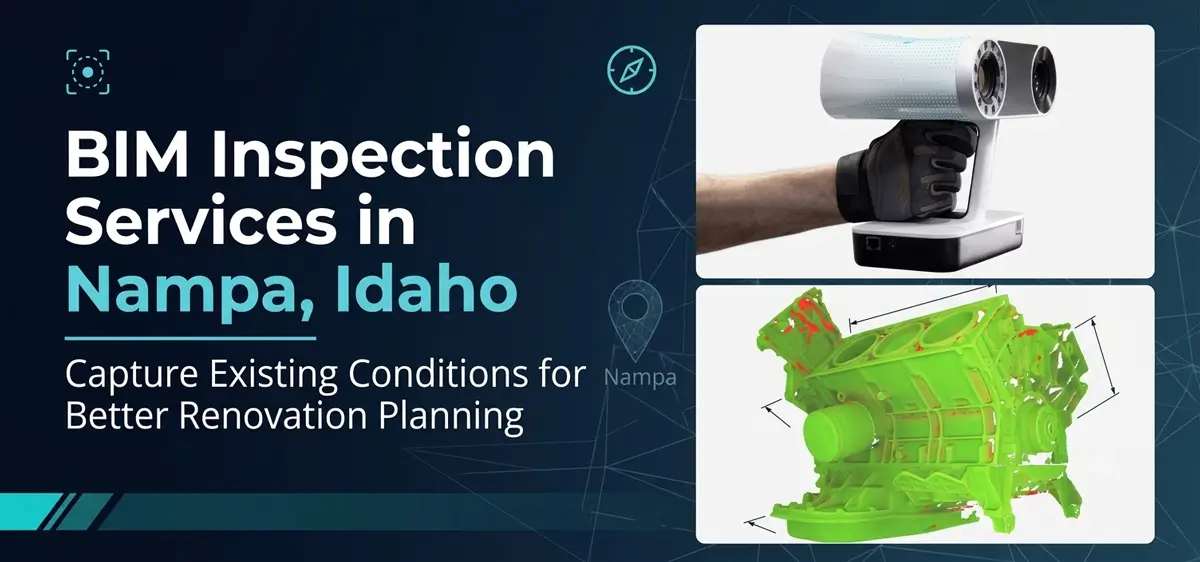
Laser scanners capture millions of points from surrounding surfaces. These measurements are processed into a point cloud that represents the geometry of the scanned building or facility.
The information can then be used as a reference for BIM development.
A typical workflow includes:
- Reviewing project drawings and identifying the areas to scan.
- Capturing existing building conditions with 3D laser scanning.
- Registering and processing the collected scan data.
- Providing point-cloud or mesh deliverables.
- Developing CAD or BIM models when required by the project scope.
This approach helps the design team work from measured site information rather than depending entirely on potentially outdated documentation.
Nampa Projects That Can Benefit From BIM Inspection
Existing-condition scanning can support a range of projects in Nampa, including:
- Commercial renovations: Document walls, ceilings, floors, columns, and other visible building features before redesigning interior spaces.
- Industrial facility upgrades: Capture equipment locations, access routes, platforms, and surrounding structures before introducing new machinery.
- MEP coordination: Provide a digital reference for visible mechanical, electrical, and plumbing systems.
- Building expansions: Document the existing structure where proposed additions will connect to an existing facility.
- Equipment installation: Review access openings, clearances, and surrounding obstacles before equipment arrives on-site.
Why Early Documentation Can Reduce Project Risk
Finding a conflict during design is generally easier to address than discovering it during installation.
A point cloud can help the project team review spatial conditions, coordinate design decisions, and identify areas that require additional investigation.
It is important to remember that a scan documents visible conditions. Hidden utilities and concealed structural components may require separate investigation methods.
Digital Scan 3D for BIM Inspection in Nampa
Digital Scan 3D provides 3D scanning, point-cloud processing, CAD modeling, and BIM-related services for clients across the United States and Canada.
Whether your Nampa project involves a commercial renovation, industrial upgrade, or new equipment installation, we can help you evaluate the scanning requirements and suitable digital deliverables.
Have a project in Nampa, Idaho? Contact Digital Scan 3D at 503.388.8888 or use our contact us to discuss your existing-condition scanning needs.